A Moral Rose By Another Name

We have all observed the conversations, perhaps even participated in them.

We have tried to find our places on the scale of what we find acceptable, excusable, or understandable as far as reactions to horrible incidents go and, subsequently, how to react to the reactions, and so on.

We can look to the past to try to understand how the dynamics have evolved, but many of us don’t.

We can look to the future to try to extrapolate how dynamics may evolve, given past tendencies and patterns, but many of us don’t.

Somehow, we have taken the mantras of “live in the moment” and “always look forward” (or “choose forward”, as the case may be) perhaps a little too literally. Imagine the chaos our roads would become if we all drove without awareness of what flanks us or what is behind us.

I’ve heard many times how the violence we are seeing now is justified (an adjustment may need to be made to distinguish between those with legitimate grievances and those looking for any excuse to harm others) and how no large-scale change ever comes about without violent uprising.

Perhaps that’s true. Perhaps it isn’t. MLK and Gandhi come immediately to mind, but my intention is neither to invalidate the point, nor to endorse it. Rather, I’d like to add different angles to ponder.

If we can justify violence under certain circumstances, what are those circumstances?

Is it the severity of the original offence? If so, where is that line? Is it death? If so, how many lives lost justify taking more lives? What is the appropriate ratio? If not death, then what?

Is it economic oppression? How much financial loss warrants a violent response and to what extent?

Is merely being treated unfairly an acceptable catalyst?

Is it the duration of the injustice? If so, how long should one tolerate it and how many avenues of recourse should one exhaust before violence becomes the only alternative?

Is it the prevalence of the injustice? If so, how many people need to be victimized? By how many offenders?

If we’re honest with ourselves, we can quickly and easily realize that, somewhat awkwardly, it’s hardly ever black and white.

Hypothetically, let’s assume there was a significant portion of the adult population, let’s say somewhere between 5% and 10% that have faced systemic and prolonged bigotry and, due to sheer ignorance, experience the escalation of it daily, despite their many contributions to society.

Let’s also assume that in some cases, intentional misrepresentation was used to amplify the ignorance and, despite being model citizens, they were, at least in the public eye, portrayed as social agitators and were always the usual suspects in incidence of crime.

Let’s also assume that in an effort to appease an increasingly fearful public, they were being forcefully separated from the property they had earned honestly and properly, presumably to encourage their departure from among our midst.

Would this be reasonable grounds for a violent uprising? Would we change our social media profile pictures and bombard the ether with platitudes of “this is what happens when” and extend our support?

Would we do all that and more if the group of people described above were peaceful and responsible owners of legally acquired and possessed firearms?

Because this time, that’s exactly who I’m talking about.

Minneapolis

I’ve started and scrapped this post so many times that I’ve lost count. Pretty much each one had a different prominent emotion from rage, to empathy, to despair, and had a slightly different angle of approach.

Sadness was constant.

I’m sad that we still live in times where the attitudes that justify the behaviour in Minneapolis isn’t the odd case.

I’m sad that racism or abuse of power or both led to the excessive force used to murder someone.

I’m sad for the family.

I’m sad for anyone that experiences hints, flashes, or obvious displays of it regularly.

I’m sad that an entire community has been pushed to the point where violent reactions seem the only recourse to express their rage against sustained injustice.

I’m sad for the countless good law enforcement officers that are just as disgusted by the atrocious actions of some of their own and will be judged based on them rather than the good work they do day in and day out in an incredibly difficult and often thankless job.

I’m sad that in the social mosaics and melting pots we once took pride in, we are increasingly intolerant of each other based on our differences, often miniscule.

I’m sad that the identity politics that progressives champion pit us against each other rather than uniting us.

I’m sad that the attitude of “you’re either with us or against us” is the prevailing attitude. I’m sad that in an attempt to bridge the gap between the proverbial black and white, there is no room for shades of grey.

I’m sad that the fragile facade of generally lawful and peaceful society remains so easily combustible on so many lines of needless division.

I’m sad that too many of us just don’t care.

Truth never damages a cause that is just.

Among Interrogation 101’s most basic techniques of determining likelihood of truthfulness is to ask the same question multiple times, from different angles and phrased differently. If the story changes, it’s highly probable that deception or avoidance is taking place.

Borders should’ve been closed, but shouldn’t be closed. Masks work, but only when they don’t, and wearing them should be mandatory, but only if we want. Hospitals should be protected so they can deal with the critically ill, except if they’re dying. Government officials are essential workers, but only in the ruling minority party.

To give credit where credit is due, the authors of the scripts Trudeau reads from every day have done a pretty good job at intermingling facts with conjecture, evidence with ideology, and science with scientism, leaving us feeble-minded underlings with enough to leave us confused enough to wait another day for clarification that never comes. God only knows what happens while we’re cowering in our homes, grateful for being forced to try to survive on financial handouts that are a fraction of what we earned before our businesses were forced to close, trying to make sense of it all and not paying attention to anything else at all.

Consistent messaging with canned responses to questions is great, too. Except when they’re given for completely unrelated questions, or when no answers at all are given. It must drive the novelists in the LPC PR room nuts to see such abject failure in the deliverology.

Yet, we’re supposed to quietly nod in placid agreement to everything that has passed through the political filters and not question how it contradicts personal experience or well-documented research conclusions? We’re supposed to shame those who question the most basic of facts, regardless of their level of expertise? We’re supposed to report those who deviate from the prescribed behavioural patterns?

Riiiiiiight.

I can’t wait to tune in to the cuckoo clock appearance to hear what I’m supposed to think today!

Negligent Discharges

On May 1st, 2020, the Liberal Party of Canada delivered on their 2015 campaign promise to “get assault weapons off our streets.”

It may seem to most that this would be an obviously effective and necessary measure to enhance public safety. In fact, the results of an Angus Reid poll released on the same day indicated 78% of Canadians support a complete ban of civilian ownership of assault weapons. That is a compelling number, and in any democratic society, where the will of the people has been gauged, if nothing else, follow-through for political reasons appears mandatory.

The late Aaron Levenstein, author and Professor of Business Administration at Baruch College, once said, “Statistics are like bikinis. What they reveal is suggestive, but what they conceal is vital.” Could there have been anything concealed in the poll results?

To the credit of Angus Reid, they also published the qualifying data of respondents . Among the various dimensions of respondents was a particularly interesting one. Among those who admitted they know little to nothing about current Canadian firearms laws, support for the ban was 89% and 88%, respectively.

Section 19 of the Criminal Code of Canada states that ignorance of the law by a person who commits an offence is not an excuse for committing the offence. Why then, do we seem to allow ignorance of existing laws and regulations to justify new ones? Can we credibly support new measures without knowing existing ones? Can we possibly have a comprehensive understanding of the nature of a problem without knowing how we have tried to address it in the past? Can we accurately predict any new measure’s likelihood of success without knowing either?

Granted, what is currently enshrined in Canadian law by means of the Firearms Act is often vague. Interpreting certain sections can prove to be a daunting task of consolidating ambiguities and self-contradictions. The related regulations are often even more confusing, where consistency seems to not have the importance it logically should. Unless one is a legal professional specializing in this particular Act, or a firearms owner who is affected daily by it, familiarizing oneself with its complexities seems a needlessly frustrating exercise. To further complicate the probability of any proposed solution’s efficacy, we must also consider the myriad socioeconomic, ideological, and psychiatric issues that contribute to the behavioural escalation trajectories of those willing to commit violent acts, regardless of instrument used, if any. It is far less cognitively and philosophically taxing to defer to the judgment of those we elect to represent us in Parliament to sort these things out; to let the experts decide.

Perhaps that’s part of the problem. With very few exceptions, there are not many bona fide experts overseeing the Ministerial operations under their watch. Furthermore, politicians are expected to evaluate each and every Bill and either escort them through normal parliamentary procedures and protocols to eventually receive Royal Assent to become law, or to abandon them on the floor of the House of Commons or the Senate, regardless of their knowledge or level of experience and expertise. Most seasoned lawyers don’t even have that depth of knowledge to be considered experts on all of them, but Members of Parliament, from all walks of life and professional backgrounds are presumed to. To whom do they defer or rely on advice from to make the most prudent decisions?

On the firearms file specifically, the Liberal Party of Canada promised to give the RCMP final say on regulations, rather than maintaining parliamentary oversight. They are the experts, after all.

Without getting into all the details and vagaries of our current classification and licencing systems, firearms that conform to the classically accepted criteria of “assault weapons” have been prohibited in Canada for decades. So why are we now re-banning what we are told are assault weapons? Our licencing system is intensive, including mandatory safety classes, spousal consent, along with any recent conjugal partners, criminal records check, medical records check, daily screening, etc. Why, if these firearms in the hands of RCMP-vetted and monitored legal owners are such a clear and present danger, and if banning them is such a crucial component of public safety, has it taken the Liberal Party of Canada nearly five years to do so?

One of the biggest reasons, aside from them already being banned, could be that the evidence clearly indicates that the vast majority of firearms used in violent and criminal incidents are smuggled across the longest demilitarized border in the world, from the highest firearm population density in the world where classifications are sometimes less restrictive around size and function. What may be legally acquirable there may not be here. Circumventing Canada’s stringent regulatory environment provides enormously lucrative rewards for those willing to take on the risks. Another reason could be that among those that do use their firearms with nefarious intent, the percentage of licence-holding offenders is so insignificant that, as general practice, no law enforcement service in the country even bothers to track it.

This seems a very inconvenient truth to the narrative being pushed, doesn’t it?

This ban comes on the heels of the worst killing spree in Canadian history, with illegal firearms smuggled from across the border. It comes when the public is already in fear of a pandemic, reliance on government intervention is at an all-time high, and Parliament’s participation is limited, with little opportunity for debate or opposition, even in a minority government scenario. It comes by means of an Order in Council (OIC), where legislative/democratic procedure is not necessarily required. In this case, the framework to allow it was legislated with Bill C-71 which became law in June 2019.

OICs are regularly used administratively for political appointments and staffing, and legislatively for regulatory amendments, most of them routine . There are, however, a few notable exceptions, not the least of which was OIC P.C. 1486, commonly known as the Japanese Canadian Internment of 1942 which saw 23,000 Japanese Canadians forced from their homes during World War 2, many into internment camps, for doing nothing wrong, and despite the RCMP perceiving no threat from them.

This coincided with and was both facilitated and mutually strengthened by the War Measures Act of 1914. That Act has been replaced with the current Emergencies Act , the same one that keeps coming up during the COVID-19 havoc. The same one that coincided with the ban announcement. It’s worth reading the referenced historical summary and drawing current parallels.

If there has been any comfort in recent times, at least as far as optics go from the government, it has been that racism has no place in Canada, and for that I applaud them. One would hope that the same mindset that breeds racism, one that adopts stereotypical generalizations on external appearance and internal ignorance, would never make it to government and would certainly not be in a position to repeat history.

Bill Blair, now Minister of Public Safety, the Minister under who the ban was implemented, was asked about possible tougher and wider measures to crack down on the gang violence problem in Toronto in 2019. He is quoted as saying, “Canada is a country governed by the rule of law. While I know too well that some in our society have no respect for those laws, the rest of us should not be robbed of our fundamental rights and freedoms because of the actions of a few.”

So what changed? Why is that statement no longer true?

The three most-signed electronic Parliamentary petitions in the history of electronic Parliamentary petitions all oppose this enormous and misguided overreach, two specifically through this method (OIC) and ask for it to be reversed. This is a dangerous precedent to be setting. While it could be firearms today, and Canadians of Japanese descent in years gone by, tomorrow it could be something that affects you.

What if radical environmentalism becomes the next opportunity to virtue signal to the world and become an election wedge issue? What if one day, an announcement is made that carbon-emitting internal combustion engines, and all vehicles capable of housing them were banned and only fully electric cars were allowed, so that we might be safe? What if, overnight, you could no longer drive your car, even if a hybrid (being a variant of an IC engine)? What if you could no longer sell it, and you could no longer transfer ownership in any way? What if you were given two years to surrender your car, after which time you would face criminal prosecution? How happy would you be?

Do events like that sound hard to believe and unlikely to happen in any area of Canadian everyday life?

They already have.

Why?

Moral and Social Decay

As if the upcoming election hasn’t been enough to stir emotions up. Listening to some rather creative statements about the state of affairs in our country, and the self-administered accolades of the current administration’s performance dripping with so much literary licence that it poses a slip hazard, or irregular landing, and watching the bought and paid for media outlets gleefully propagate messaging that anyone with even the slightest bit of knowledge could poke holes big enough to vent all the evil carbon dioxide from our atmosphere into the deepest and darkest corners of the universe, where, I’m almost convinced, far too many people seem content to park their cognitive reasoning capabilities as they mindlessly lap it up, is enough to depress the happiest of souls.

Then came the murder of Devan Selvey.

Not since the murder of Tim Bosma has the community so publicly rallied together to support not only the family of the victim, but also each other, in the wake of such horrific crimes that few still can’t process how they could have possibly happened here, in our neighbourhoods, in our backyards. While it IS shocking and upsetting, it seems that complacency, on so many fronts and on so many issues has left far too many people with a false sense of invincibility and a false sense of security. It is impossible, in far too many cases, to convince people that we really do reap what we sow, and to get them to project down the path we’re on to some horrifying outcomes. This, despite several current and recent past examples of where what is currently masquerading as Liberalism leads. Is this case a direct result of both policy and the social norms that have both demanded them and then been fostered by them? Probably not, but policy and the expectations set don’t help.

There are many tangents to possibly veer wildly off on at this point, but I’ll refrain. I’ve commented on those before, and will again, but not here, and not now.

I sat in front of the TV last night, watching coverage of the vigil being held for the young Mr. Selvey and was again, filled with so many emotions.

There was the shock, of course, still very much at the surface, even after so many days of hearing details trickle out.

There was anger. How is it that evil incarnate is allowed to dwell among us with no effective measures of preventing escalations to the point of brutal murder being implemented or even available? What kinds of people are these that would premeditate an attack on a 14 year old? What goes on in their minds where murder is somehow rationalized as a justifiable end? What of the parents of the accused? Did they recognize the warning signs? Did they seek help, and if so, were they turned away? If not, why not? Or did they, like so many people, especially some of our political leaders, put their heads in the sand and rock themselves to sleep, clinging to the delusional belief that these things will balance themselves? How would I have reacted if it was my child being murdered? How would I have reacted if it was my child murdering another?

Most of all, however, there was a deep sorrow. A young life snuffed out, for reasons that we may never fully know or understand. Other young lives ruined by what will surely be the aftermath of murder convictions. Familes left with wounds that will never heal but may become more comfortably numb over the passage of time. So much tragedy, and this is but one of countless similar cases that have all the mallmarks of potentially reaching the same outcome.

During my senate testimony, I opined that C-71, along with most proposed gun control measures, misses the mark completely on issues affecting a reduction of violence since it is based on the false pretense of the availability of firearms as being an enabling and catalytic factor in the manifestation of violence. I suggested that what we are seeing is the result of the cumulative effects of moral and social decay. I think the Selvey case clearly demonstrates that. The perpetrators did not use firearms to commit their heinous act.

Can you imagine how different the conversations would be, though, if they had?

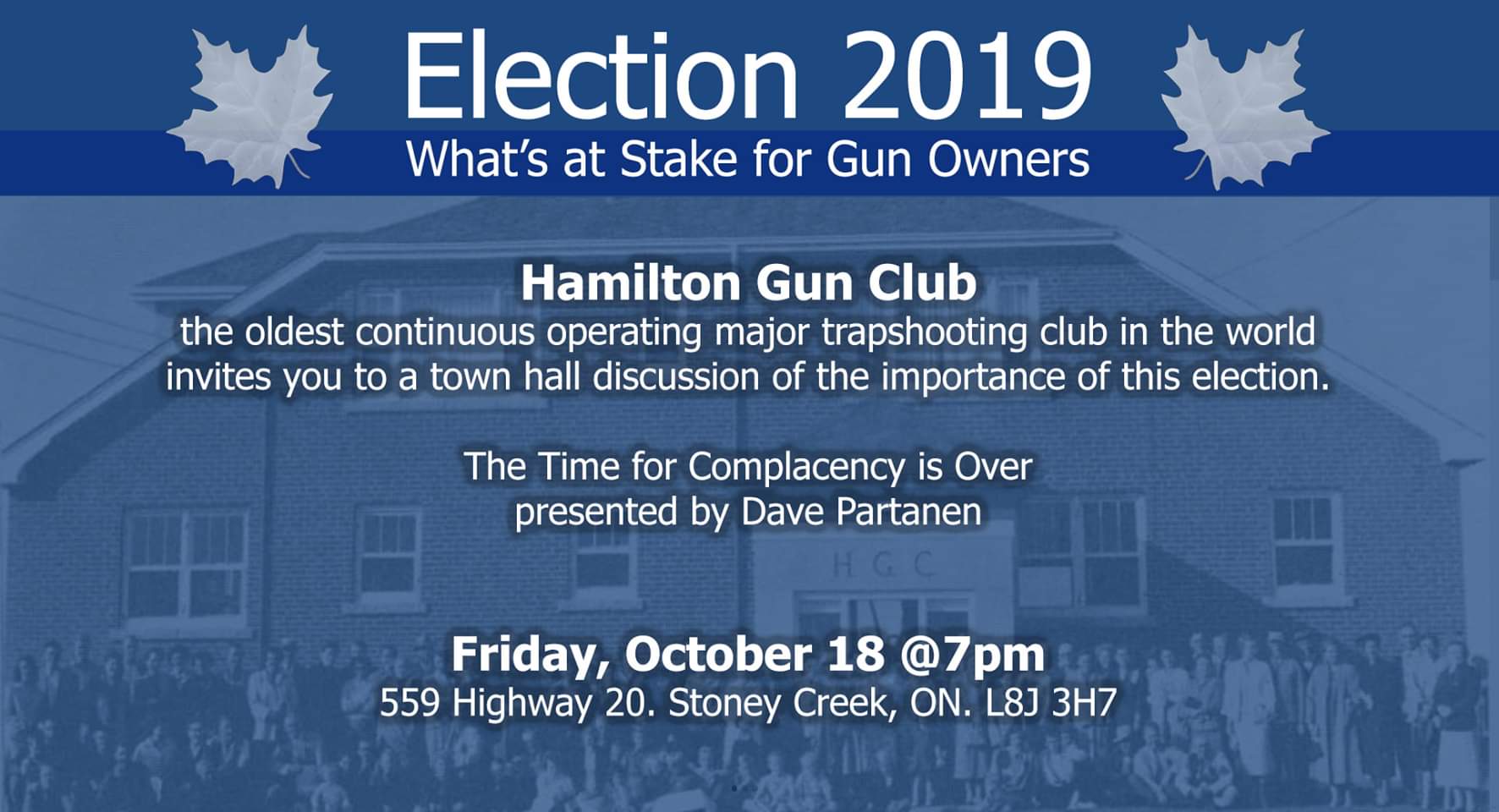
Election 2019 – What’s at Stake for Gun Owners

Dave Partanen is the Vice President of Publications and Research, as well as an Ontario Director for the Canadian Coalition for Firearm Rights. He also regularly contributes content to High Capacity Magazine and shares his views on a number of sociopolitical topics on Facebook and the soon to be officially launched blog, The Social Observer Effect.

As a former Director of Crime Stoppers of Hamilton, and having interacted with law enforcement, community grassroots organizations, and various research professionals, Dave has built and continues to build a knowledge base of not only the issues that plague many of our communities, but also some of the approaches that have proven to be effective in mitigating risk factors, both locally and abroad.

Although all of this has shaped Dave’s perspectives, he will present neither as a representative, spokesperson, or advocate of any organization. He is, instead, speaking as an individual concerned citizen.

Please join Dave, a number of other speakers to be announced shortly, and fellow citizens, legal firearms owners or not, as he brings his experience to the floor to discuss what the outcome of the general federal election means to the future of crime prevention and to the future of legal firearms ownership in Canada.

The event

Coming soon!

The principle of the observer effect is that the mere observation of something alters its behaviour.

In a world where we are easily distracted and our focus is misdirected, we will strive to bring not only attention to the issues that are often obscured or obfuscated in the hopes of affecting change for the better but also collaboratively inspire viable solutions and action plans.